


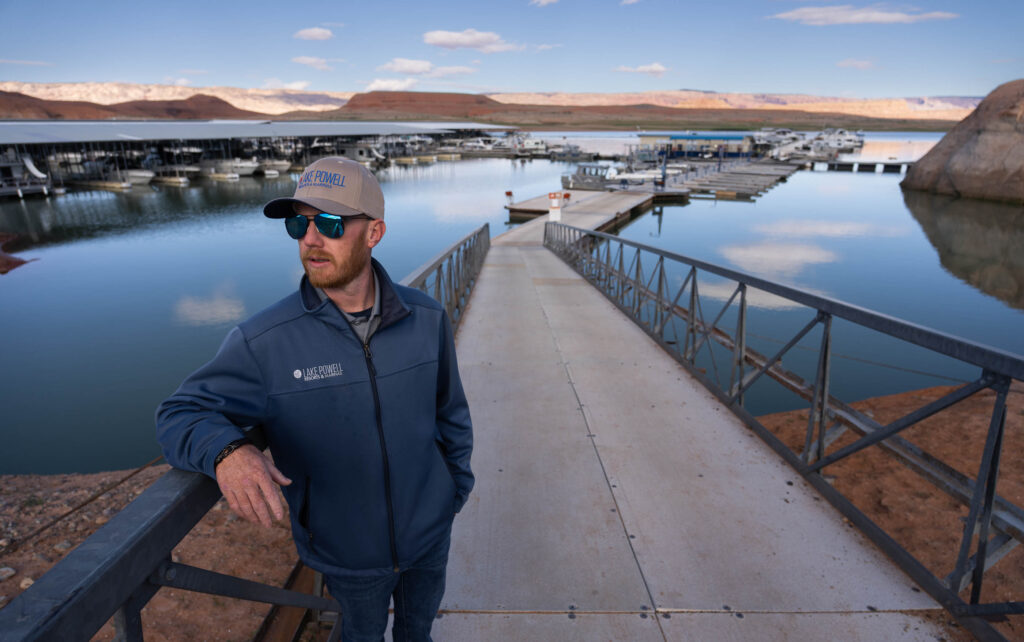
Titus Crawford spent four days calling Lake Powell boaters this spring. After a record low snowpack and off-the-charts March heat, the reservoir was on track to dip so low that Bullfrog Marina would have to move from its namesake bay.
As a captain and director of the popular marina, Crawford knew he needed to call the owners of the roughly 350 boats docked there year-round.
“There’s definitely concerns,” he said. “The biggest portion of it, however, are just happy to be able to keep their boats in the water. …We were very, very lucky that we were able to move this entire operation to another location and continue to be a full-service marina.”
Crawford and his crew began relocating the Bullfrog Marina to deeper water near Halls Crossing on May 4. The relocation process will take about four to six weeks to complete, Crawford said. The boat rental and fuel dock were already moved to Halls Crossing at the end of March.
“There’s just not going to be enough water here shortly to sustain the Bullfrog Marina where it is,” Crawford said.
The marina’s new home near Halls Crossing has “a lot deeper water,” he added. “It’ll be a lot more of a resilient location for us as the water levels change.”
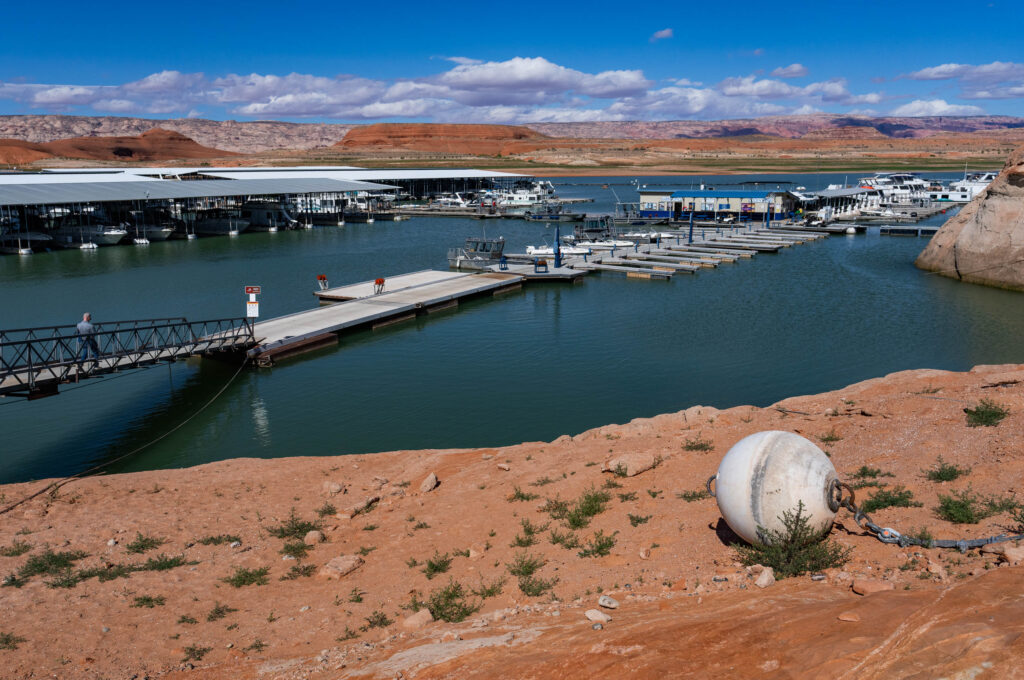
Bullfrog Marina is one of four remaining marinas around Lake Powell. The Bullfrog North Launch Ramp is also just one of two launch ramps that remains open to public motorized vessels, according to the National Park Service, but the agency warns to “launch at your own risk.” The other open ramp, Stateline Auxiliary, is on the southwest end of the lake at Wahweap.
The park service is constructing a primitive ramp at Bullfrog to allow “boats to be launched and retrieved throughout the summer,” a park service spokesperson said over email. Aramark, the park concessioner that manages marinas and lodges around the lake, is also working to further extend the Wahweap Stateline Auxiliary ramp, the park service said.
Moving a marina
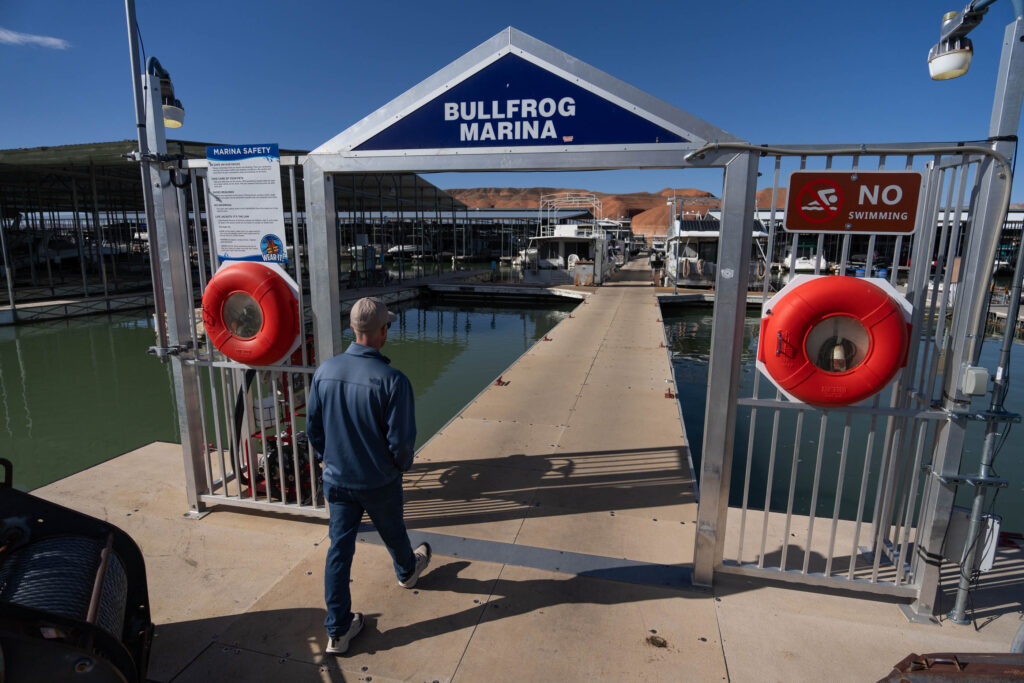
Over the next few weeks, marina staff will use tugboats to push whole docks — including giant houseboats with waterslides — at a slow 1 mph pace to the marina’s new home three miles south, Crawford said.
“It’s all floating,” he added while walking along the dock on a calm and sunny morning in late April. “So as we disconnect anchors and cables, we can set new ones and move on to a new location and just push it with tugboats.”
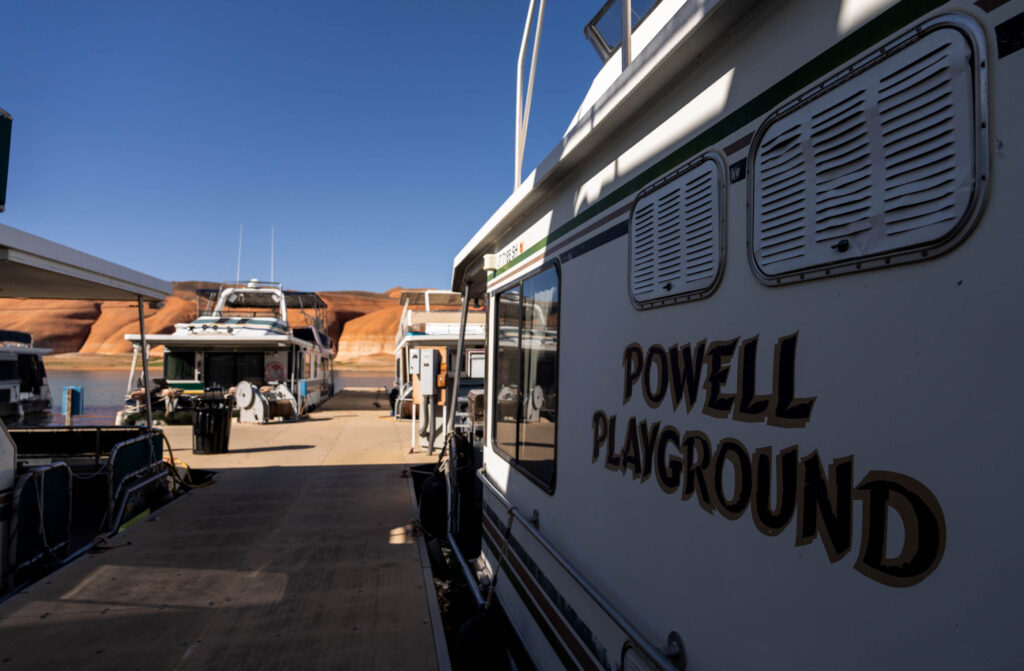
While the marina is only moving three miles down the lake, there’s not a direct road between Bullfrog and Halls Crossing, so it will add about an hour to the drive for visitors from the north.
Crawford is exploring the possibility of running a water taxi to shuttle people to their boats from Bullfrog’s old home to the new location. He’s still working out the logistics but said he’s hoping to have a plan figured out once the marina move is complete.
Some small work vessels, particularly towboats, will remain at the former Bullfrog Marina location so staff can quickly access them for emergencies, Crawford added. Those boats, and the dock, will have to move around as the water level continues to drop.
“Due to the low water, there’s a lot of operational changes we’ve got to make,” Crawford said.
Once the rest of the marina is relocated, staff will continue to commute from Bullfrog to the new location each day. Staff live in housing, including dormitory-style units and mobile homes, in Bullfrog provided by Aramark.
“It’s going to be a little bit interesting commuting back and forth across the lake every day,” Crawford said, “but all of our staff will still continue in their same positions at the same marinas.”
Witnessing a changing lake
The new work commute will feel familiar to Crawford: he used to take a boat back and forth between Halls Crossing and Bullfrog, where he attended school as a kid.
“[It] is a little bit different than riding the bus,” he said.
Crawford has called Lake Powell home much of his life. His mom was a store supervisor at Halls Crossing Marina and his dad worked at the same marina in harbor maintenance.
Crawford and his wife even got married on a beach at Lake Powell, booking out half the Defiance House Lodge and renting two houseboats for their guests.
“It was definitely fun getting to explore as a child,” he said. “And then as I grew up, starting to get into driving boats myself, getting my captain’s license, actually really seeing and understanding what was going on was a lot of fun.”
Just over 10 years ago, Crawford started working at the reservoir, too. His first job was on the Charles Hall Ferry, which connects State Route 276 across the reservoir.
The ferry, managed by the Utah Department of Transportation, used to travel between Halls Crossing and Bullfrog in 25 minutes. It’s not running this year, though, due to the low water levels.
Over the years, Crawford and the boaters he’s come to know have seen the lake levels fluctuate. “It’s a different lake now,” he said.
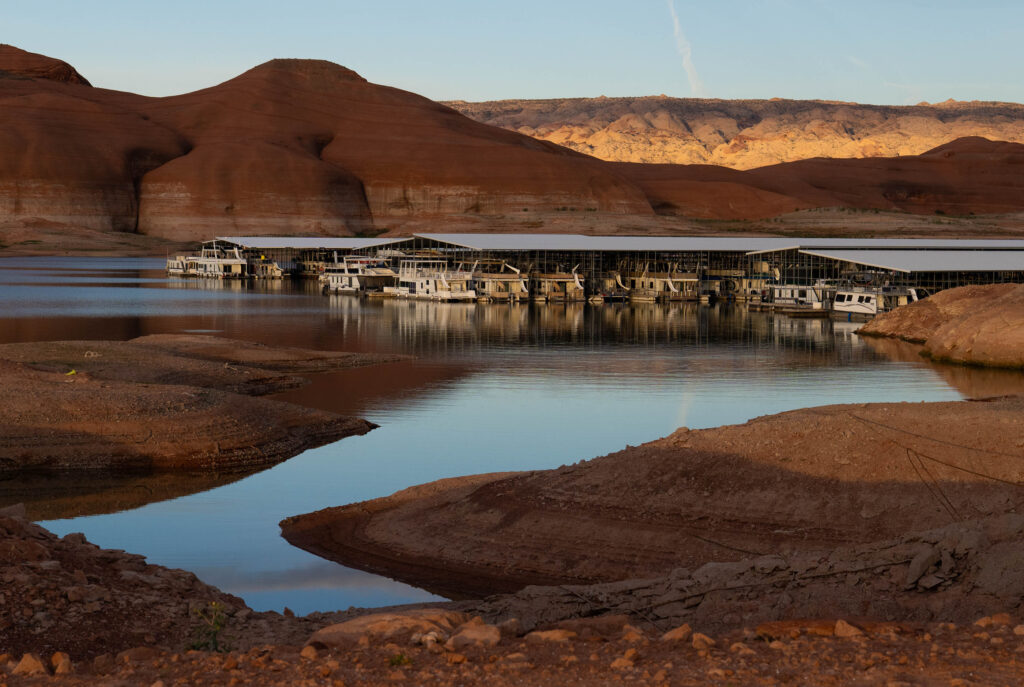
Before the current move, the Bullfrog Marina has had to make several adjustments. When the reservoir was at its peak in the 1980s, the marina was nearly a mile back, Crawford said.
In late April, the marina’s power, water and sewer lines that floated in the lake just three years ago — after a record high snow year — hung down a dry rock cliff.
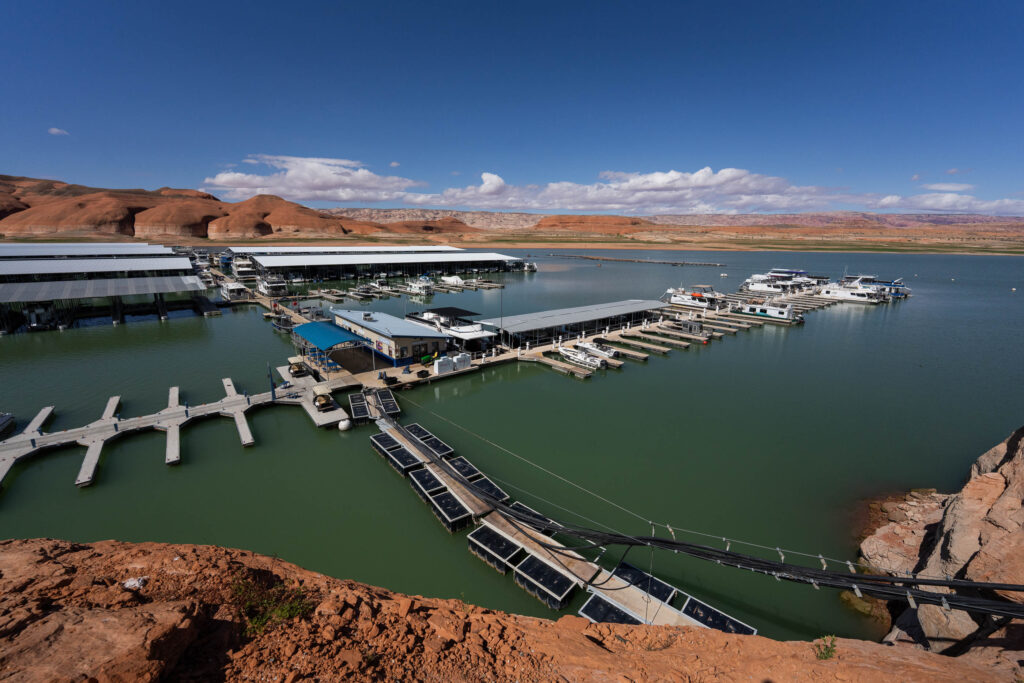
Beyond marina shifts, the way Crawford and visitors experience the vast reservoir has also changed.
A canyon that may have been shallow and wide in the past, Crawford explained, now just has a narrow strip of water for boats to squeeze through towering 110-foot walls. The “bathtub rings,” bands of once orange sandstone that now look bleached, remind boaters where the lake formerly reached.
“As the lake water has gone down, there’s been a lot of fun new beaches, new coves, new canyons — stuff that people haven’t seen in generations coming out of the water,” he said. “It’s definitely a good time to explore it.”
Over the last month, he’s taken three groups on private tours to Cathedral in the Desert — a large chamber, lit from a narrow gap in the sandstone walls overhead, that ends at a small, trickling waterfall.
“It’s calm, it’s quiet, very rarely actually sees the sun,” Crawford said. “So it’s just amazing.”
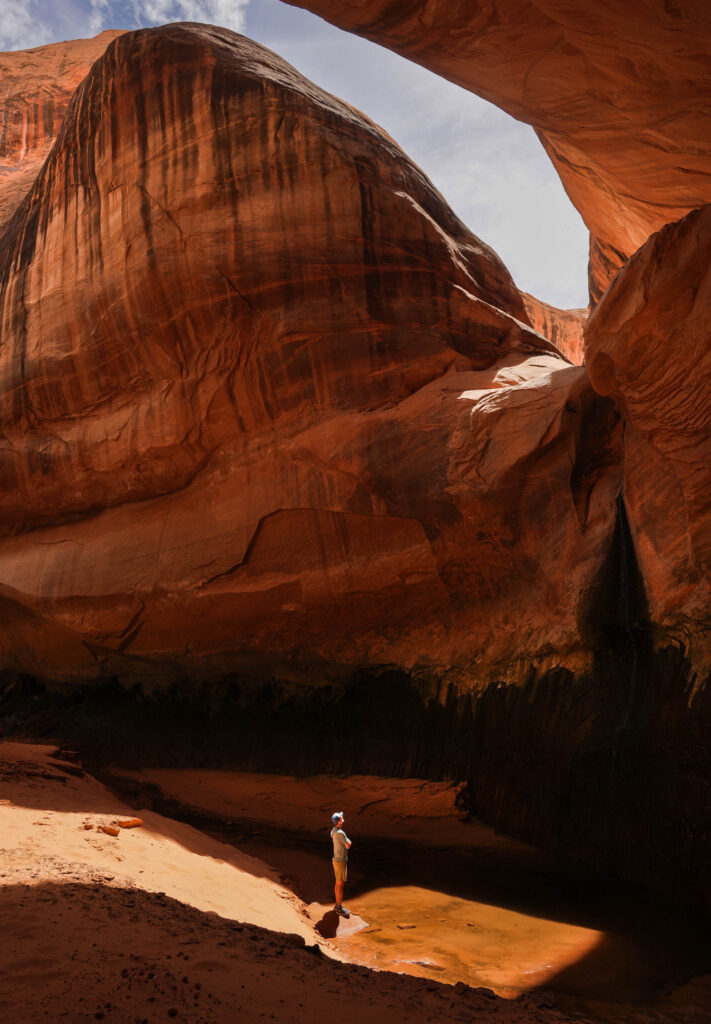
Increased visitation to the formerly little-known spot has left its mark, though. Graffiti, including names and years written with charcoal, now covers the orange sandstone walls.
“We definitely discourage it, but there’s not much that we can do about it,” Crawford said.
Park service staff “educates the public about the damage of graffiti through direct education to school classes and volunteer service groups,” a park spokesperson said over email. That includes in-park programming, informal visitor conversations, junior ranger booklets, social media and more.
Graffiti isn’t the only challenge the park service has as the lake changes, though. Low water levels “expose new boating hazards and reveal sensitive resources,” the park service said. Rangers have to manage increased congestion and more inspections for invasive quagga mussels at each launch area because of fewer ramps.
Adjusting boating infrastructure as the lake drops is also costly. The park service plans to award a contract this December for the design and construction of a new ramp at Stanton Creek, which will be the eventual home of Bullfrog Marina. The park service estimates the project will cost $73.4 million.
“The project is complex due to fluctuating lake levels, the need for significant in-water construction and the requirement to run new utilities to support the relocated Bullfrog Marina adjacent to the new ramp,” the park service said.
This article is published through the Colorado River Collaborative, a solutions journalism initiative supported by the Janet Quinney Lawson Institute for Land, Water, and Air at Utah State University. See all of our stories about how Utahns are impacted by the Colorado River at greatsaltlakenews.org/coloradoriver. It was produced in partnership with The Water Desk at the University of Colorado Boulder.