

This story was originally published by Aspen Journalism on November 19, 2026.
Without the assurance they were looking for from federal officials, Colorado water managers have decided that a state-run conservation program won’t include agricultural water users in 2027.
The decision came at the regular meeting of the Colorado Water Conservation Board Wednesday, with the board walking back a September decision to proceed with a state-run conservation program. State officials will continue working with the U.S. Bureau of Reclamation and the CWCB will consider a more limited program at its January meeting.
“It’s too late for agricultural projects,” said Taylor Hawes, who represents the Colorado River mainstem on the CWCB. “Perhaps there’s just a small group of [nonagricultural] projects we could move forward to show we’re doing something.”
By excluding farmers and ranchers, Colorado can be expected to contribute little water next year to an Upper Basin program that aims to boost levels in Lake Powell by paying water users to cut back. Utah and Wyoming officials are still moving ahead with conservation programs that include agricultural users in those states.
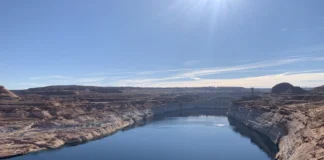
In September, the state water board approved the application review process and criteria for what state officials are calling Colorado’s near-term contribution program for 2027. The program aims to use $100 million from Reclamation to pay water users to temporarily cut back. The water would be saved in one of four reservoirs: Lake Powell, Flaming Gorge, Blue Mesa or Navajo.
But state officials don’t want Colorado water users to cut back only to boost Lower Basin users’ supply. The CWCB’s approval in September depended upon securing an agreement with Reclamation that any saved water would be “operationally neutral,” meaning it would not be factored into reservoir releases to the Lower Basin (California, Arizona and Nevada). Reclamation has not given that guarantee, and with time running short for irrigators to plan for the 2027 season, state officials decided to pull the plug on agricultural projects.
“We are very late in the year at this point,” said Amy Ostdiek, interstate section chief with the CWCB. “It would be really challenging, I think, for a lot of agricultural water users to consider enrolling at this point without this certainty.”
Not saving so others can overuse
The amount of water released from Powell each year is based on how much water is in the reservoir. Colorado officials are concerned that if their state’s conserved water contributions bump up levels in Powell, it will trigger more water to be released downstream to be used by the Lower Basin. This could trap the system in its current cycle of overuse and prevent states from building back storage in the reservoir, which has been depleted by decades of relentless demand and climate change. If the conserved water was operationally neutral, it would not be counted in determining how much water is released each year.
Becky Mitchell, Colorado’s representative to the Upper Colorado River Commission, said at Wednesday’s meeting that the state wants to be able to “say to the water users, ‘You’re not just saving so that others can overuse.’ I think that’s the crux of it.”
In a Nov. 10 letter to Upper Basin officials, Andrea Travnicek, Reclamation’s assistant secretary for water and science, said the terms and conditions of how conserved water may affect reservoir operations will require a larger seven basin state conversation. (Colorado, New Mexico, Utah and Wyoming comprise the Upper Basin.)
“There is currently no water within the Colorado River Basin that is considered operationally neutral,” the letter reads. “Until such agreements are made, reservoir operations will continue to be based upon the physical elevations.”
A conservation program would be open to all water-use sectors, and at least one Front Range water provider has expressed interest in participating in the 2027 program by forgoing some of the water it uses from the Colorado River basin. But in past pilot projects, all of the conserved water has come from Western Slope agriculture.
Western Slope water managers want the pain to be shared across the basin and by cities, too. And they say rural agricultural communities should not cut back just to fuel use in the Lower Basin.
“Look, we’re happy to participate and help Reclamation protect its facilities at Glen Canyon,” Mueller said in an interview with Aspen Journalism. “We’re happy to set up a pool to make sure we stay in compliance with our obligations under the compact. But no one wants to dry up productive agricultural ground or economic activity and industry or the cities in our state in order to just send water down to fill swimming pools in Scottsdale.”
Mueller was among Western Slope water managers who had asked state officials not to rush to start a program next year if they couldn’t get guaranteed operational neutrality from Reclamation.
“I think everybody would benefit by your continued thoughtful approach rather than trying to rush to get something in place,” Kirsten Kurath, an attorney who represents irrigation districts in the Grand Valley, some of the biggest water users on the Colorado River in the state, told board members Wednesday. “We really would encourage you not to implement a program that does not recognize operationally neutral credit to the Upper Basin states.”
Feds still working with states
Agriculture is seen as the low-hanging fruit when it comes to water savings because it uses most of the basin’s water. But traditional conservation programs that pay agricultural water users to not use water for a season have been a tough sell in Colorado. This is the second time that state officials have balked at starting a program. From 2019 to 2021, nine workgroups explored a potential temporary, voluntary, compensated program, which was then known as demand management. But the CWCB declined to implement one, shelving the issue instead.
Upper Basin water managers have maintained that any conservation in their states will be a literal drop in the bucket, doing little to boost levels in Lake Powell. Under the federally funded System Conservation Pilot Program, which ran in 2023 and 2024, the Upper Basin saved about 101,000 acre-feet at a cost of $45 million. Colorado’s share of that was about 24,300 acre-feet, a tiny fraction of Powell’s storage capacity. Precipitation has a much bigger impact than any cuts the Upper Basin can make, as was clear after this fall’s rainstorms and flooding across the Southwest.
“Lake Powell has gained about 1.3 million acre-feet over the last month and a half,” Ostdiek said. “And just to put that in context, that would be 26 years’ worth of system conservation pilot program, based on the numbers that we’ve seen previously. I think it provides a reminder that the system is largely driven by hydrology.”
Federal water managers say they are committed to working with the Upper Basin states toward an agreement that will account for and verify contributed water; establish a mechanism for the states to obtain credit; and establish operating rules for storage and release of saved water.
The federal government has taken over river management after the seven states that share the river failed to come to an agreement after years of tense negotiations. Two states, Nevada and Arizona, have now sued the Department of the Interior over Reclamation’s operating plan, which was released in August. The plan for 2027 and 2028 lays out a basic framework for cuts in the Lower Basin and reservoir releases. But many details beyond that remain to be worked out in separate agreements between the states and Reclamation.
And more lawsuits could be a part of the basin’s future. In Wednesday’s meeting, the CWCB approved increasing Colorado’s litigation fund to $10 million (from $6 million), with $4 million of that going to the Colorado River Basin, the largest allocation of any river basin in the state.
Mueller told Aspen Journalism that the CWCB probably did the right thing by postponing agricultural projects for 2027, but that it’s still frustrating to not have agreement between the Upper Basin states and Reclamation on key terms, such as operational neutrality. And he’s not optimistic about seven-state conversations.
“It represents some dysfunction in the governance structure that’s managing the river right now,” Mueller said. “I would hope that our states find a way to knock those discussions loose so that we can actually have meaningful conversations about this and some other key elements of a potential governance framework.”