


In early June, water experts gathered at the University of Colorado Boulder to talk about the future of the Colorado River.
The lifeline for 40 million people in the Southwest is in dire shape. Too much demand and not enough supply has sapped its largest reservoirs. And in discussions of western water the finger-pointing on who is the best steward of the region’s scarce water can ramp up quickly.
So when a panel of state-level water negotiators took the stage, one finger pointed directly at the expansive green lawns outside the university’s law school building.
“There is a metric shit ton of turf grass on this campus,” said John Entsminger, Nevada’s top Colorado River negotiator, to the room of western water policy experts.
Entsminger used a less than precise measure, but CU-Boulder is blanketed in rolling quads, athletic fields, and decorative grass. Entsminger runs the Southern Nevada Water Authority, an agency that has prided itself on city-scale turf removal, and has said Las Vegas’s water conservation effort is the reason behind its ability to grow in population and stay within their Colorado River allocation.
College campuses across the nation play host to oasis-like landscapes. Some qualify as designated arboretums, others give shaded and grassy sanctuary to students, staff, faculty and community members. A beautiful campus is also a selling point for prospective students, which is why grounds and maintenance crews work year-round to upkeep the trees, shrubs and lawns.
But universities in the West are beginning to contend with water-intensive landscapes as water availability decreases. The approaches in finding the balance between a green, inviting campus and responsible water stewardship are a mixed bag. Some universities continue to irrigate away, while touting their sustainability goals, while others aim to set a new standard for university landscaping in the West.
In Boulder, ditch water rules the day
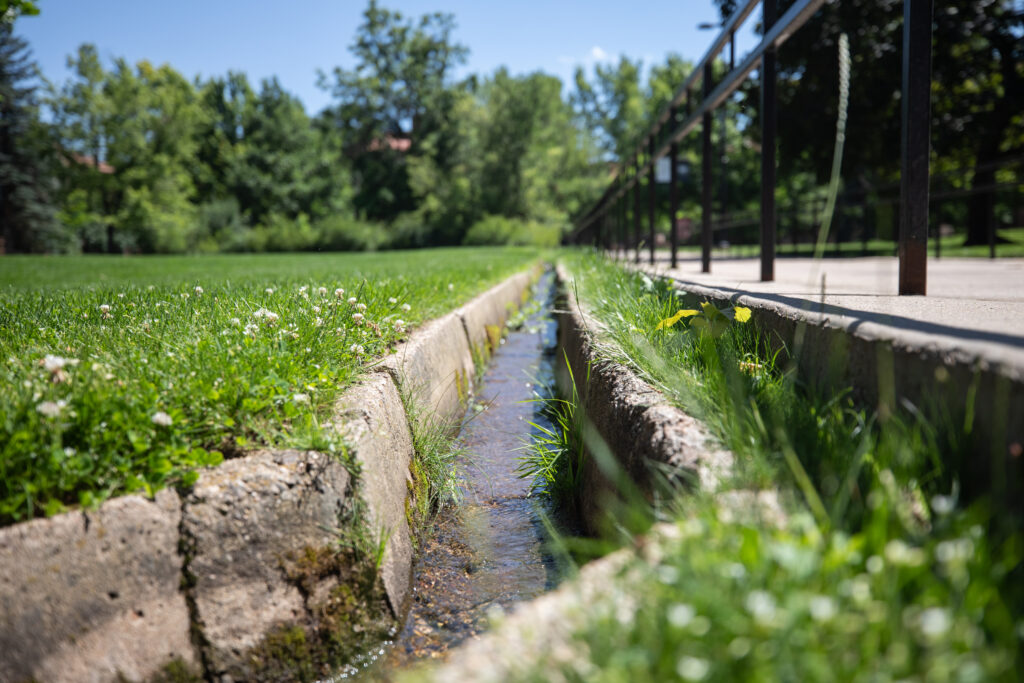
The University of Colorado Boulder irrigates most of their campus through the Anderson Ditch system — a senior water right that has been held since 1860 and pulls raw water directly from Boulder Creek. The senior rights allow the university to irrigate quads and landscaping features freely even though the city of Boulder has been under voluntary watering restrictions since April 1.
Following the city’s restrictions announcement in early April, CU Boulder addressed the issue in a statement, stating that, “the Outdoor Services team at CU Boulder uses all of these tools to make informed decisions about when to irrigate areas of campus, and for how long.” The statement broadly suggested students, staff and faculty conserve water by limiting watering to essential plants and trees, being efficient with water use, fixing known leaks, and being mindful of everyday use.
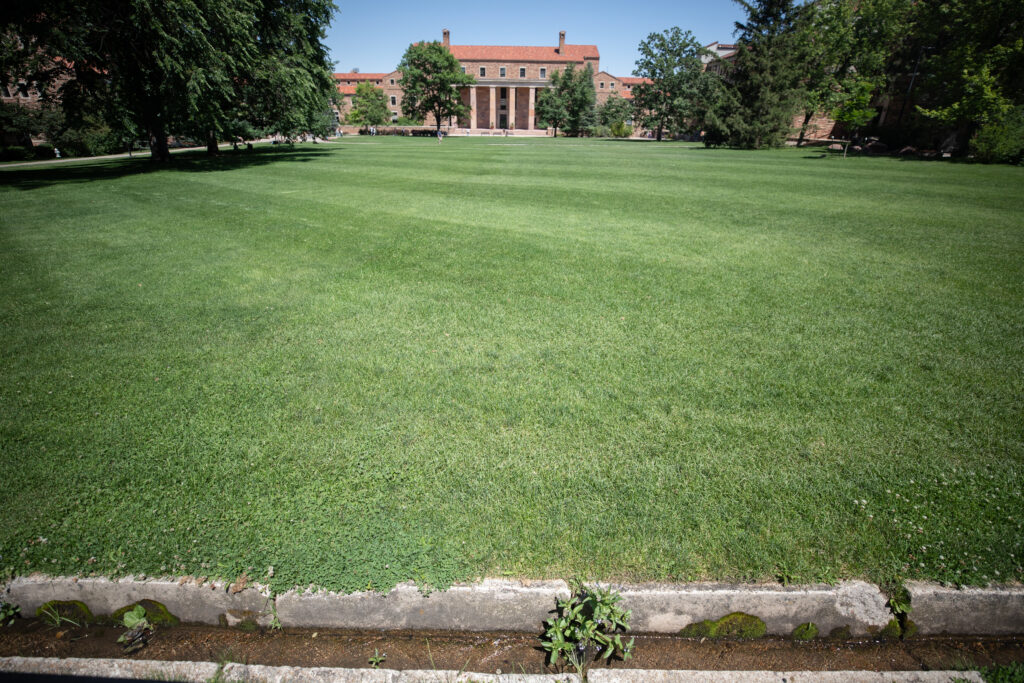
CU did not respond to an interview request, but in an email response, the university said that only 10% of the campus uses potable city water for irrigation. The other 90% is irrigated with water via ditch systems: the Smith and Goss Ditch and the Anderson Ditch which pull from Boulder Creek.
“We prioritize efficient and responsible water use across campus and continuously adjust operations based on weather, soil conditions and overall system performance,” the university said in the same email. CU uses an automated monitoring system to assess levels in ponds used for water storage, pulling from the ditch only for replenishment.
Because of the senior water rights used to irrigate the campus, CU can justify continued irrigation. “To our knowledge, neither [Smith and Goss Ditch or Anderson Ditch] has ever been called out of priority or required to cease operations due to insufficient water flow in Boulder Creek,” CU’s Strategic Relations and Communications Team said in an email response.
But deferring to separate water rights does not solve the problem of a shrinking supply. Although CU’s irrigation water is not part of the city’s potable water supply, it still has to come from somewhere; Boulder Creek is fueled by snowmelt high in the Rocky Mountains, which continues to be threatened by warming temperatures.
The university claims its approach to water use is flexible. In the case that water restrictions tighten, the university says it will reevaluate, “working to conserve water while maintaining a safe, sustainable and vibrant campus environment.”
But for other universities across the West, the current amount of water going to irrigation is not sustainable. Some are looking for creative ways to both maintain their campus and reduce water use at the same time.
In Albuquerque, a university with a golf course
In 2024, the University of New Mexico used 182 million gallons per year to irrigate its nearly 800 acre campus. On top of that, it used 43 million gallons per year to irrigate its 9-hole North Golf Course, and 234 million gallons a year to irrigate its 18-hole Championship Golf Course. Most of the 459 million gallons of irrigation water comes from a groundwater well system that was established on the campus in 1904.
“Western water law doesn’t do any favors to conservation,” said Anne Jakle, director of the office of sustainability at the University of New Mexico. “The ‘use it or lose it’ philosophy is not helpful.”
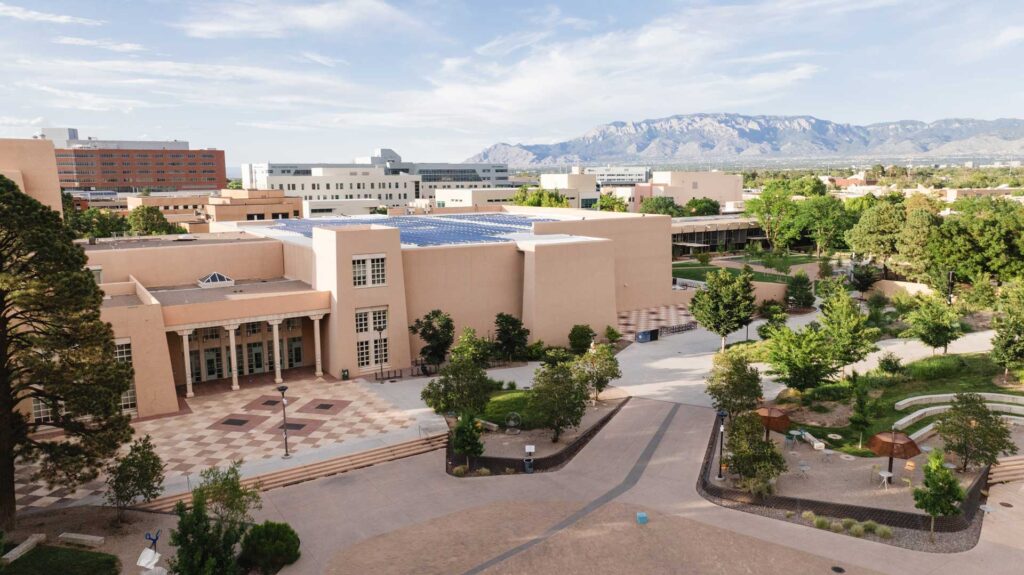
Of the North Golf Course’s 43 million gallons, around 7 million are reclaimed water. The university is using blowdown from a utility chiller tower to help water the golf course, an effort that comes on the heels of a project that cooled and reused water to help the university conserve 2.8 million gallons of water each year.
UNM’s campus, located in Albuquerque’s high desert climate, is decorated with more landscaping than occurs naturally. “We’re an open campus too, so people from the community are here all the time, utilizing it, recreating,” said Jakle.
According to Jakle, members of the community seek refuge on the campus from the urban heat island effect, which can artificially raise the temperature in an area due to surrounding materials absorbing heat from the sun. This can be curbed by the cooling shade of a tree canopy.
The university is planning a 20% reduction in water use by 2030, outlined by the UNM Sustainability Strategic Plan released in 2025. “Our goal is not to maintain a lush campus indefinitely as it exists today,” UNM Facility Services said in a statement response, “but to thoughtfully transition to a landscape that remains beautiful and functional while using less water.”
One of the strategies UNM is using to eliminate excess water use is to target non-functional turf, or grass that serves no purpose beyond aesthetics. The goal is to replace those plots with native species through xeric landscaping, which will not only use less water, but promote ecological health by attracting pollinator species.
But eliminating decorative grass is not without its challenges, and those challenges are not unique to UNM.
A Mojave desert university struggles to keep its trees
The University of Nevada Las Vegas spearheaded efforts to remove excessive grass from their campus located in the Mojave Desert starting in the late 1980s. But since removing over 1 million square feet of turf, conserving what the university estimates to be 77 million gallons of water a year, tree die-out has become a major problem.
“We removed so much grass that we’re noticing the effect on the trees,” UNLV grounds superintendent James Kearney said. “The trees are all dying or suffering.”
Tree die-out extends beyond the campus. In early 2026, some Las Vegas residents filed a lawsuit against the Southern Nevada Water Authority, claiming their grass removal incentives and mandates have killed tens of thousands of trees.
The university is focused on utilizing native species for landscaping design. Those native species should, in theory, be resilient enough to survive the conditions of the Mojave Desert without irrigation. However, UNLV irrigates those plants, too.
“We found that even if it’s a native species, it’s beneficial to still irrigate it,” Kearney said. “[They] should survive without any irrigation, and it’s possible, but it’s not going to look great.”
On UNLV’s campus, trees require more water than native plants. Both trees and native plants are irrigated by the same drip systems; the system can’t differentiate between a water-intensive tree and a native plant.
Targeted irrigation could help the plants and reduce water waste by giving different plants and trees their own valves. But that transition would be costly. And according to Kearney, it is an intensive process. “You’re either tunneling under a sidewalk or ripping out and repouring concrete, so you don’t really have a choice,” he said.
Cost and labor are not the only prohibitive measures a university faces when battling irrigation challenges. For some, the source of their water is just as prohibitive.
In Golden, Colo., city water restrictions force change
Because of the source of its water, Golden’s Colorado School of Mines is faced with a problem of not knowing exactly how much is used for irrigation. The city supplies the school with all of its water. According to grounds manager Roger Jensen, this water is not metered by use, which means the university can’t measure how much is used for irrigation on campus versus how much water is used in buildings.
Despite not knowing how much water is being used for irrigation, conservation efforts persist. Over the course of the summer, Mines’ baseball field will be converted from natural turf to synthetic turf. It will be the last of the five full-size fields in their athletic complex to be converted to synthetic turf.
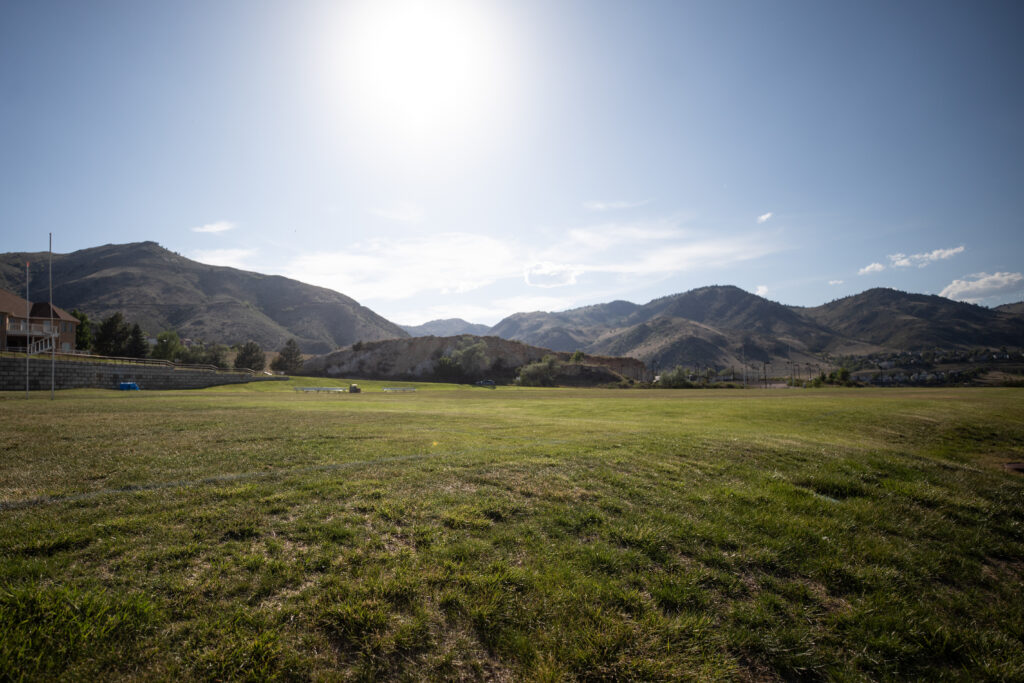
“That cuts a lot of water out,” Jensen said. By his estimate, around 1.5 million gallons of water were used to irrigate just that one baseball field over the course of two academic years.
Regardless of the change on the baseball field, the university still manages club sports fields and quads that are natural grass and require watering through an underground drip system.
“We know that having this lush green campus, this oasis, is not a natural thing,” Jensen said. “It’s a balance between maintaining what we’ve inherited from generations past, providing insight and advocating towards more ecosystem-appropriate plantings while still honoring that oasis-feel.”
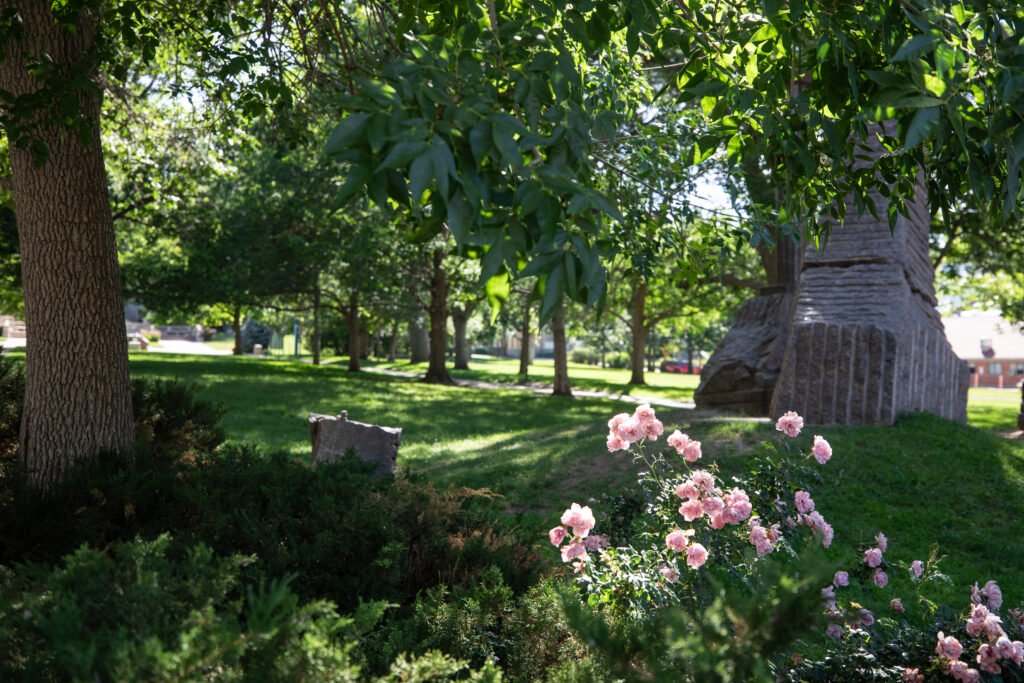
This is the first year that School of Mines has been put under mandatory watering restrictions by the city of Golden.
“Back in 2012, it was rough, but there were no water restrictions,” Jensen said. The city is not so particular about the underground drip systems, so long as they are optimized and in good repair. “This time, they’re saying two irrigation days a week,” he said.
The thought to remove non-functional turf to reduce water use is common among universities in the West; some have to take it a step further in order to grapple with a changing climate and dwindling water supply.
Turf removal ramps up at ASU
Contending with a shrinking supply of Colorado River water, the senior administration at Arizona State University employed grounds teams and landscaping architects to look at ways to remove turf grass from the campus within the last few years. “That took everyone by surprise,” said Norman Yatabe, senior project manager of the office of the university architect and landscape architect at ASU.
Yatabe says that eliminating turf grass is “low hanging fruit,” and that it is the easiest and most effective way to reduce water usage on campus. At ASU, ground cover, shrubs and native plants mimic the green, verdant landscape expected of universities, and do so with less water.
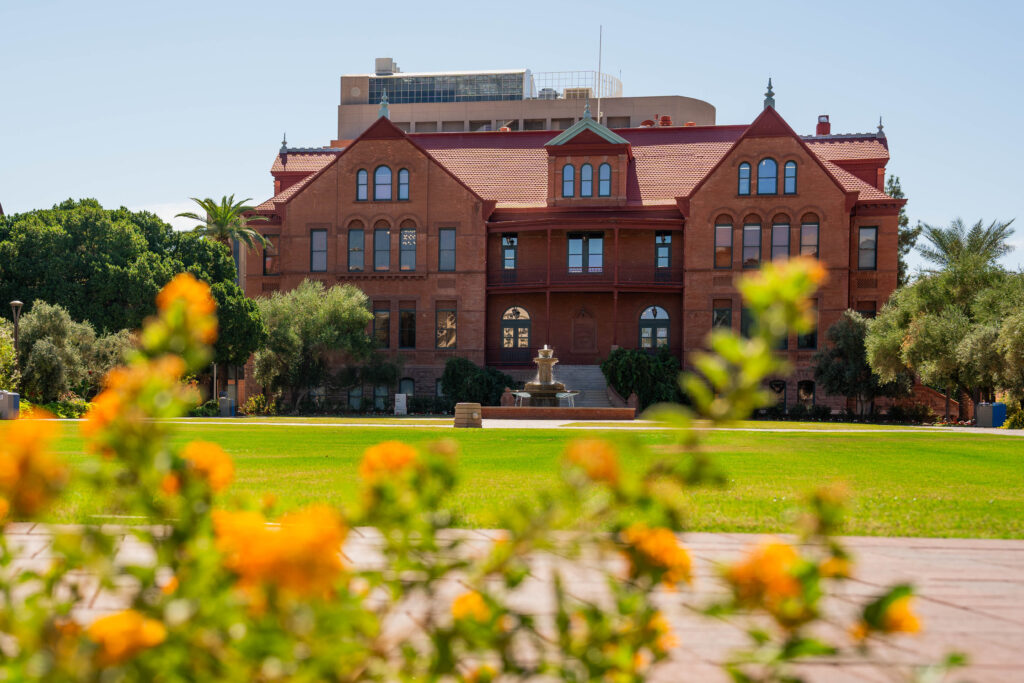
ASU uses potable city water on its East Valley, Polytechnic, Downtown and Tempe campuses, and groundwater from wells on the West Valley campus. Because it uses city water, the university must work within municipal water restrictions as they come.
Looking to other solutions, ASU has begun to passively collect rainwater from summer monsoons that do little to recharge groundwater supply due to evaporation and rapid runoff. The university does not store the rainwater, but instead uses it in bioswales and rain gardens. “The rainwater flushes out a lot of the salts that are in the ground,” Yatabe said. Because of a lower salt content in these rainwater gardens, Yatabe says they are observing better plant growth in these areas.
In addition to rainwater collection, ASU is capturing condensate from air conditioning systems in new buildings to use in landscaping planters.
According to Yatabe, one of the most important initiatives for limiting water use is changing the perception of what campus greenery is. The plants may look different as the climate warms, he said. “We’re constantly being forced to adapt and change to these varying conditions, ever-changing conditions.”
This story was produced and distributed by The Water Desk, an independent reporting initiative at the University of Colorado Boulder’s Center for Environmental Journalism.